
I’ve come to realize that one of the ways I learn is through my interactions with people. I learn about what matters to them, the way they behave, and perhaps quickly discover that we actually have some things in common.
During my CTRT Training, I learned that in a CTRT conversation, what I offer the other party is an experience – of me applying Choice Theory. As I apply Choice Theory, I also find myself having the opportunity to teach Choice Theory through my behaviors, instead of simply downloading information.
In my application of Choice Theory, I strive to apply the Connecting Habits (left-hand side) and stay away from the right-hand side.
Fun fact: I tend to complain quite a bit as a learned behavior, and I’ve found that doing so hasn’t brought any long-lasting satisfaction into my life.
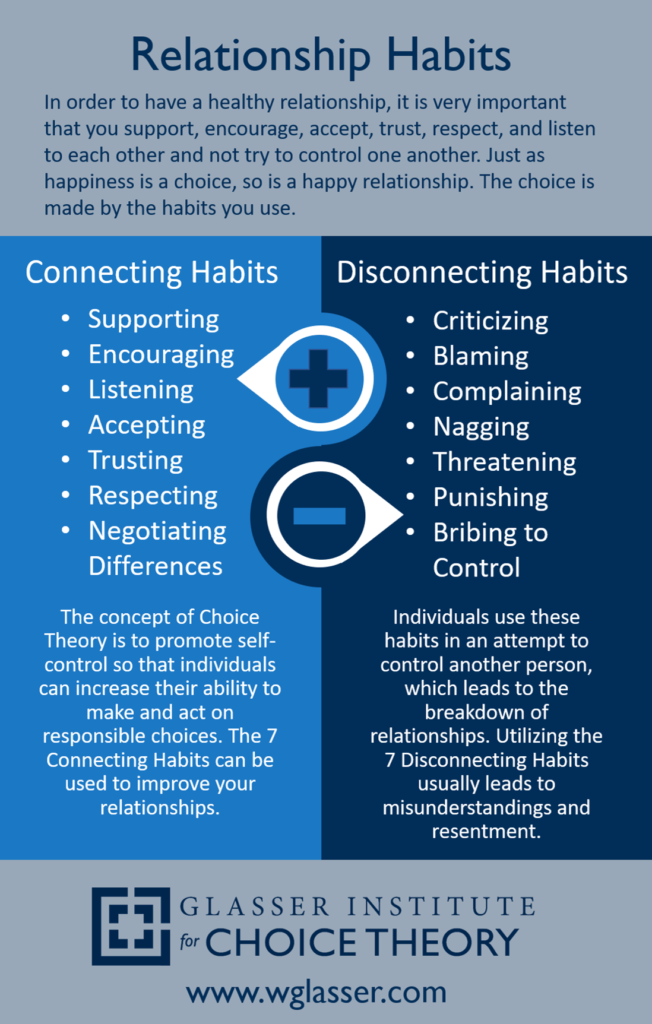
1. I can teach myself Choice Theory by practicing the 7 connecting habits with myself first.
I’ve had times where I allowed my behavior to be driven by anger. When I do so, what I may be telling people through my body language is that ‘Wilson is someone who is unapproachable.’
I tried three times before I managed to use 3 connecting habits with myself.
In an example of a failure to get a parking space:
In my head, I told myself: ‘I am upset because I didn’t get a parking lot. It is not my fault that I did not get the parking lot. I want to have the space to think about it and regain control of my emotions.’
- I accepted that I was upset.
- I stopped blaming myself for not being able to get the parking lot.
- I started reminding myself that I can trust myself as a planner.
- I negotiated differences with myself: ‘Okay, I can’t have the parking lot, but I still want to remain in control of my emotions.’
I was able to break the loop of thinking negatively (Situation A of Choice Theory Brain Chart) and entered Situation B of Choice Theory Brain Chart) in a span of 15 minutes to gain control of my behaviour.
When I think about how I took 1 entire day of being upset on my previous attempts… I think I’ve come pretty far.
What I learned in having a relationship with myself is that I am capable of growth as long as I continue trying.

2. I can teach others Choice Theory when I practice the 7 connecting habits in my attempts to give information.
In the span of the 15 minutes where I was driven by feeling upset, I had an annoyed look on my face. With this expression, I told the person, ‘I don’t want to talk about it now because talking about it does not help.’
In my head, there was a picture of me speaking very calmly and saying, ‘Ah yes, could you give me some space?’ I tried my best to maintain a poker/calm face, but alas, my voice still came out annoyed, even though I was thinking of things as rationally as I could.
The person, upon receiving the information that I was annoyed, started to perceive blame and went into self-blame too. I then realized that because everyone’s perception is different, I can help myself out by giving information about what’s within my perceived world and what I want.
Later on in our interaction, I took one additional step by saying, ‘I’m sharing this information with no intention to blame. I might look annoyed at the moment, but in my head, I’m waiting for my emotions to catch up. Is it alright with you if I had some space to process things?’
In doing so, I’ve communicated that I have accepted the person’s perception that I look annoyed. I also shared my perception that I’m waiting for my emotions to catch up.
Taking on this new behaviour, I’ve also taught the person that I am choosing to take control of my situation instead of remaining upset.
3. I can teach others about a life in Jesus, as I live out my life in Him.
5 In your relationships with one another, have the same mindset as Christ Jesus:
6 Who, being in very nature[a] God,
did not consider equality with God something to be used to his own advantage;
7 rather, he made himself nothing
by taking the very nature[b] of a servant,
being made in human likeness.
8 And being found in appearance as a man,
he humbled himself
by becoming obedient to death—
even death on a cross!9 Therefore God exalted him to the highest place
and gave him the name that is above every name,
10 that at the name of Jesus every knee should bow,
in heaven and on earth and under the earth,
11 and every tongue acknowledge that Jesus Christ is Lord,
to the glory of God the Father.
Philippians 2:5-11 NIV
While I was in a car with a group of friends, I was sharing about how strongly I resonated with teaching Choice Theory through how I interact with others.
Then, I had an epiphany that perhaps this was one of the ways I teach people about Jesus.
By having the mindset of Christ, I can learn to be like Him and demonstrate His love, joy, peace, forbearance, kindness, goodness, faithfulness, gentleness, and self-control towards others and myself.
My intention would not be to prove that I am Christ-like, but rather to sow seeds and share what God has given me through His Spirit. As I demonstrate more of it in my immediate relationships, I also teach people how I apply His teachings in my life.
Over the years, I’ve heard reasons about why it’s important to join a cell.
a) Learn about God’s word
b) Be accountable to each other
If there was an official list, I would want to add these to the list:
c) To experience and learn the love of God through others
d) To share and teach what I’ve learned about the love of God with others.
I think that learning is a lifelong journey – and I will continue to learn and teach others through an application to my life.