I take insights from reading God’s Word, format them into a structured teaching, and hope to inspire perception shifts in those who listen.
This approach feels natural—it’s how we’ve been taught to share knowledge.
But the responses to these lessons vary widely. Some people recognize the information and hold onto it. Others keep only what resonates with them, and still, others discard it altogether.
When someone recognizes the information, they assign a value to it—positive, neutral, or negative. A positive value might lead to excitement, a neutral response might sound like, “It was okay,” and a negative value could arise if the lesson touched on something painful or challenging.
For the longest time, I thought that recognition and retention of information were the keys to growth.
But I’ve come to see that behaviour shifts matter too.
Christian growth, in my opinion, isn’t about simply knowing more. Growth is about transformation—how knowledge shapes how we live. I’ve come to believe that behavior is made up of four components:
Acting: What we physically do.
Thinking: The thoughts that guide our actions.
Feeling: The emotions that arise.
Body Language (Physiology): How our non-verbal cues express what’s within.
When we align our acting and thinking with God’s truth, our feelings and body language follow naturally. Growth in behavior means having all four components—acting, thinking, feeling, and body language—working together to glorify God.
Here’s an example: There was a time when I was deeply worried about my finances. My thoughts were consumed with wondering what I could afford to eat, and my natural reaction was to constantly check my accounts.
But then, I remembered “Seek first his kingdom and his righteousness, and all these things will be given to you as well” (Matthew 6:33, NIV).
I decided to act differently.
Instead of chasing after solutions, I focused on prioritizing God’s kingdom. I continued my spiritual disciplines and gave God both my time and finances, even though it felt counterintuitive.
Over time, my thoughts shifted as I trusted God’s promise to provide.
Gradually, my feelings of peace grew, and even my body language changed.
My shoulders weren’t hunched with tension, and my interactions with others reflected calm assurance rather than anxious energy.
Where Perception Meets Behaviour
For me, the real challenge is bridging perception shifts into behavior shifts. I believe this is where the Holy Spirit works most powerfully, taking the truths we recognize and turning them into lived reality.
It’s not about perfection. Some days, I see how far I’ve come; other days, I see how far I have to go. But what encourages me is knowing that growth isn’t a single moment; it’s a lifetime of aligning more closely with God’s heart.
My preliminary thoughts that made sense to me is this:
If I continue to be set in my ways (my acting and my thoughts), then it is unlikely that I would gain new information/perspectives from God by living my life the same way.
If I continue to add on in my sets of behaviours of Christ-like behaviour (which also includes reaching out to people), then I can grow from what God is showing me in my daily interactions with people.
There is time and space for direct information giving as a teacher – there is also time and space to consider if collecting new information without applying the information in our world, is helping us grow our set of behaviours too.
In my cells, we switched from the leaders preparing lessons, to the cell members providing questions and answering each others’ questions.
This year, we will be including some lessons prepared by the cell leaders for some direct information giving – the cell is a space for everyone, for both kinds of learning paths.
A Question for Us
Growth often involves both perspective shifts and behavior shifts, and the two are often closely connected.
As we reflect on our journey, how might our perspective and behavior be related to each other in ways we haven’t yet considered?
Forming a consensus within a cell group is a powerful process that unites members toward a shared vision while respecting individual goals.
Through years of practice and learning, I’ve identified three core elements that were helpful in forming the foundation of a meaningful consensus:
Church Vision: The consensus must align with the overarching vision of the church. This ensures that the cell remains part of the larger body, contributing to its mission and growth.
Cell Leaders’ Goals: As spiritual shepherds, cell leaders’ objectives guide the group’s spiritual direction and community-building efforts. They must reflect their vision in the consensus.
Members’ Goals: Each member’s personal and spiritual aspirations are vital. Incorporating their goals ensures the cell is a place of growth and support for everyone involved.
Including a Cell Theme
In the cells that I am in, we include a cell theme—often inspired from a passage of Scripture.
The theme serves as a spiritual anchor, providing direction and inspiration for the cell’s journey throughout the year.
Examples of such themes that we have used:
True Disciples of God (John 12:36)
The Reality of Christ (Luke 9:23)
Building God’s House
Key Realizations for Effective Consensus
Over the years, I realize that forming a cell consensus goes beyond listing goals. The following principles have proven essential to creating a unified “we” picture.
The Cell Consensus is a “We” Picture, Not a “Me” Picture
A consensus represents the collective aspirations of the group, not just individual desires. It’s a shared commitment to growth, purpose, and unity that transcends personal preferences.
Support the “We” Picture, Even if Parts Don’t Fully Align A consensus might include elements that don’t perfectly align with every individual’s goals. However, the commitment to the group’s collective vision requires focusing on the bigger picture and supporting it wholeheartedly.
Communicate the “Me” Picture for Inclusion Each member’s goals and aspirations are valuable.
Each member is responsible for communicating their “me” picture as much as possible.
If you don’t communicate the “me” picture to the cell, the consensus may exclude it. Communicating the “me” picture also does not mean automatic inclusion into the consensus—
However, if the “me” picture is in alignment with the church vision and there are no conflicts with other things in the consensus, we have hope that it would be included.
This communication builds a sense of belonging and mutual respect.
Practical Steps for Building Consensus
Start with Prayer: Seek God’s guidance for a vision that honors Him and reflects His purposes for the cell group.
Facilitate Open Dialogue: The cell leader’s role is to facilitate safe platforms for sharing and practice as much of the 7 connecting habits as possible. Encourage members to share their goals and thoughts. Use tools like surveys or group discussions to hear everyone’s voice.
Clarify the Church’s Vision: Discuss how the cell’s activities and goals fit within the larger framework of the church’s mission.
Combine Goals: Merge the input from leaders and members to create a cohesive vision. Highlight areas of overlap and align individual aspirations with group objectives.
Commit to the Vision: Ensure every member understands and agrees to the consensus. A united commitment makes it easier to navigate challenges and remain focused on shared goals.
Conclusion
A well-formed consensus reflects the heart of a cell group: unity in diversity.
By prioritizing the “we” picture, supporting the collective vision, and communicating individual goals effectively, a cell group can grow spiritually and relationally, honoring God through their shared journey.
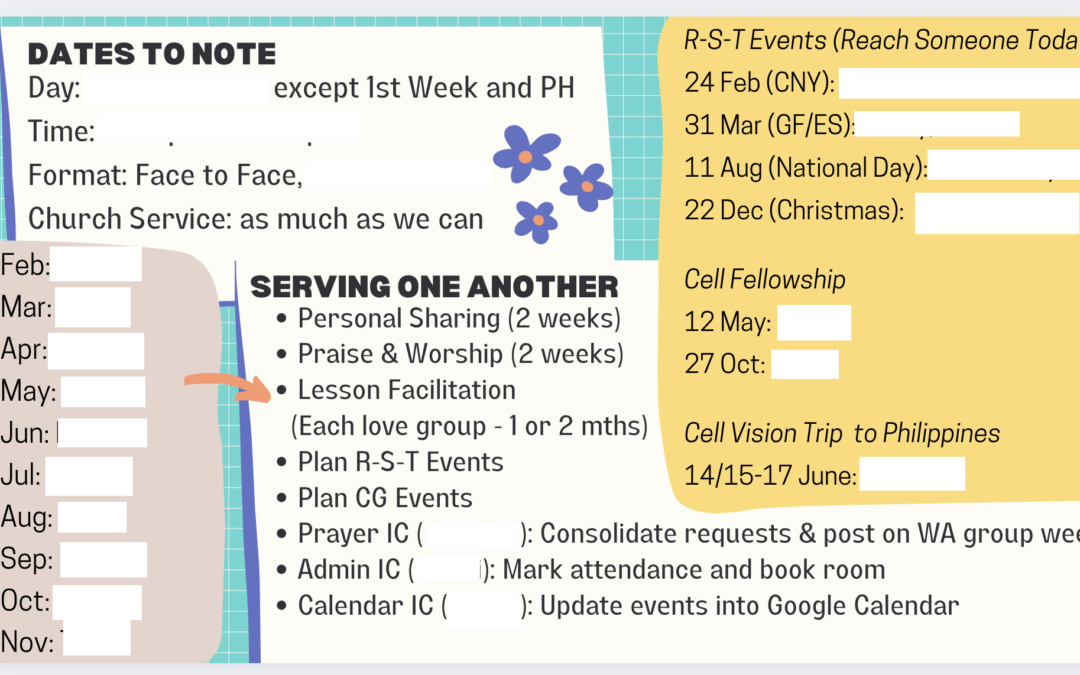
Planning the cell group schedule a year ahead is not just about organising events but about creating a rhythm that allows us to grow in the Lord, stay rested, and build relationships.
Collaboration, reflection, and a focus on spiritual growth through intentional service and rest are at the heart of this process.
Why Plan a Year in Advance?
Direction: Reflecting on past successes and challenges ensures intentionality.
Collaboration: Involving everyone builds ownership and shared commitment.
Growth: Serving becomes an opportunity to grow in the Lord, not just a task.
Rest: Scheduled breaks help recharge and ease transitions into busy seasons.
Consistency: Sticking to the agreed plan fosters trust and reliability.
Starting with a Framework
Each year begins with key questions:
Is the current weekly schedule still suitable for everyone, or do we need to adjust it?
What did the group enjoy and appreciate about last year?
Are there areas for growth or new initiatives to try this year?
These reflections help build a framework for the year. We plan events across categories to ensure balance.
Fellowship Events: Strengthening relationships within the group.
RST Fellowship Events: Bonding with a known cell.
Outreach Events: Connecting with pre-believers and others outside the church.
Cluster Events: Building relationships with unfamiliar cells.
A framework provides direction while leaving room for adjustments and collaboration.
Collaborating on the Details
We leave details, such as who will lead an event or when it will take place, open for discussion.
We avoid suggestions or nominations to encourage an environment where people volunteer for or take ownership of roles they feel called to.
When someone offers a suggestion, they clearly present it as a recommendation, not a directive.
A shared agreement on “growth in the Lord” shapes the planning process, and roles are seen as opportunities for spiritual growth.
As 1 Peter 4:10 says, “Each of you should use whatever gift you have received to serve others, as faithful stewards of God’s grace in its various forms.” (1 Peter 4:10, NIV)
Prioritising Rest
Seasoned cell leaders understand December is often a holiday season, and planning for rest ahead leads to a smoother transition into the holidays.
Abruptly stopping a lesson or continuing on with very small numbers risks disengagement and disruption.
By scheduling a break intentionally, the group stays aligned with the natural flow of the year, giving members the opportunity to recharge and reflect.
Rest isn’t just practical—it’s deeply spiritual. God modeled rest in creation, and Jesus invites us to find our rest in Him. “Come to me, all you who are weary and burdened, and I will give you rest.” (Matthew 11:28, NIV)
Young adults juggle commitments like work, friends, self-learning, dates, studies, wedding planning, and, for some, raising children. We often transition from season to season in a very short time, sometimes unexpectedly. By planning the schedule early, we create clarity and allow members to prioritize their commitments without unnecessary stress.
At the end of the day, I want my members to know that as much as I care about us serving together, I care about resting as well.
Rest is not just a pause but a time to realign with God, recharge, and prepare to serve with joy and energy in the next season.
Reflection
I used to ask members on a piecemeal basis with regards to their attendance at events. I would implore them to pray about it, to sacrifice their time in the name of serving the Lord.
but I’ve also learnt that there is also time and space to respect each of our prior commitments, and often it is about availability, and communicating early, not because of unwillingness.
In my three years of co-planning a year ahead, I saw years of events with people turning up willingly —because we as a group respected each other’s time, plans, and commitments.
When considering the question, “What is a leader?” I move beyond titles, roles, or hierarchical positions. Leadership, especially in a Christian context, is about influence, service, and guiding others closer to God.
True leaders inspire change not by demanding compliance but by modeling faith, humility, and love. Jesus Himself exemplified this servant-leadership, washing His disciples’ feet and inviting them into a life of deeper purpose and connection with God.
While exploring this idea, it becomes essential to shift focus from “leader” as a title to “leading” as a behavior.
Leading is something everyone can practice, regardless of position or recognition.
If leadership is continually framed as a role or status, those around us may hesitate to embrace leading as an active way of living.
Additionally, some who are already leading as a behavior may not recognize or embrace that they are doing so.
The behaviour of leading is the ability to serve and lead people closer to Christ, and it is accessible to every follower of Christ.
What Defines Leading ?
Influence Over Authority
Leading influences hearts and minds. Influence grows not from wielding power but through integrity and alignment with God’s will.
Proverbs 4:23 reminds us to “Above all else, guard your heart, for everything you do flows from it.”
Servanthood as Strength
True leading begins with service.
Jesus taught, “Whoever wants to become great among you must be your servant” (Matthew 20:26).
Leading serves others in love, creating trust and empowering those they guide.
Vision Anchored in God
Leading requires a clear sense of direction rooted in God’s Word. Those who lead guide others toward Kingdom purposes, using wisdom from scripture to inform their vision.
Empathy and Relational Wisdom
Leading listens to and understands the needs of others. As Paul encourages in
Philippians 2:3-4, “Do nothing out of selfish ambition or vain conceit. Rather, in humility value others above yourselves, not looking to your own interests but each of you to the interests of the others.”
Examples of Leading I’ve Seen
Leading can take on many forms in everyday life. Here are some examples that show how people actively lead others closer to Christ:
A cell member teaching another person about the Holy Spirit, encouraging spiritual growth and understanding.
People encouraging each other during down moments by praying together, offering strength and hope through shared faith.
Perspectives shifting as individuals share their life stories, inspiring others to see God’s hand in their own journeys.
People inviting others to church events, creating opportunities for them to encounter Christ.
People sharing the Word of God with others, planting seeds of faith through scripture and testimony.
As someone who is a leader, I demonstrate leading people to Christ, as well as leading using the consensus, in hopes of inspiring others to do the same in the future.
Promoting Leadership vs. Raising Leading Individuals
Promoting people is often perceived as raising leaders. However, this approach can go against the spirit of internal control.
When members say, “I became a cell leader because someone asked me to do so,” it lacks the personal conviction of “I became a cell leader because I wanted to do so.”
True leadership arises from a desire to lead others closer to Christ, not from external appointments.
For clarity, I prefer to call Raising Leading Individuals as Inspiring Leading Individuals, as it better reflects the intent and spirit of encouraging others to lead out of personal conviction.
Inspiring Leading Individuals
Inspiring those who lead involves creating an environment where others can grow spiritually, emotionally, and intellectually. This is not about replication but about nurturing God’s unique purpose for each individual.
Model Leading in Action: Aspiring individuals learn best by observing seasoned ones. Demonstrate consistency in prayer, humility, and decision-making. Be transparent in struggles and victories to show the reliance on God that true leading requires.
Empower Through Discipleship: Invest in others by teaching, mentoring, and encouraging them to pursue God’s calling. Like Paul did with Timothy, build up their confidence and knowledge in scripture (2 Timothy 2:2).
Encourage Ownership and Responsibility: Allow emerging individuals to take initiative and make decisions, even when mistakes are inevitable. Such experiences develop resilience, wisdom, and dependence on God.
Pray for Their Growth: Regular prayer for those you mentor is foundational. Ask God to equip them with spiritual wisdom, perseverance, and the fruits of the Spirit (Galatians 5:22-23).
Cultivate a Culture of Accountability: Leading flourishes in environments of mutual encouragement and accountability. Surround those who lead with others who will challenge and uplift them to stay aligned with God’s purposes.
Why Inspiring Leading Individuals Matters
God’s Kingdom advances when individuals are developed to spread His message and disciple others. Leading is not about amassing followers but creating more who can lead their peers closer to Christ.
The ultimate vision is to see individuals actively leading people closer to Christ, shaping lives for His Kingdom. Jesus’ Great Commission in
Matthew 28:19-20—“Therefore go and make disciples of all nations”—
reminds us that leading is a multiplication process.
Those who lead people closer to Christ build others up so that the mission of leading people closer to Christ continues and grows.
A Call to Reflect
In organizations, we are appointed a leader based on our skillsets and perhaps our job experiences. In His Kingdom, we are leading people to Christ as a result of our lifestyle.
I do not believe in appointing people to leadership positions simply to increase capacity in hopes they will eventually lead others closer to Christ.
Instead, I believe in increasing the number of individuals by leading people closer to Christ who are actively leading people closer to Christ before they are appointed to leadership, as their commitment to doing so is already evident.
Are you ready to lead people closer to Christ where God has placed you?
Are you intentionally inspiring individuals within your family, church, or community to lead people closer to Christ? The harvest is plentiful, but the workers are few (Luke 10:2).
Step into your role in leading and invest in others who will continue God’s work.
To me, a leader is someone who is in the active business of leading people closer to Christ.
Of course, I think each of us have our own bandwidth and experience in leading people closer to God, and there are qualifiers in various ministries.
Leadership starts from leading someone else, apart from myself, closer to Christ. And instead of defining a leader, I think it is more helpful to define leading.
And you may be already in the business of leading people closer to Christ.
Consensus results from careful negotiation. This negotiation process is an active, intentional practice where we seek alignment not just among ourselves but with the Lord’s will. It’s a journey that requires listening, humility, and a shared commitment to honor one another and God’s purpose for our group.
When we talk about “negotiating a consensus,” it’s not about bargaining or compromising for the sake of convenience. Instead, it’s about discerning together, refining our shared vision through prayer, discussion, and mutual respect.
I always begin by asking, “What is your hope from journeying together as a cell?” This question sets the stage for understanding what God has placed on each person’s heart.
Identifying Shared Priorities
As members share, we look for common threads. Negotiation involves bringing these priorities together, making sure everyone’s voice helps shape the shared vision.
Sharing Something Different
In my experience, sharing something different—an idea, a perspective, or a hope—has often sparked new understanding. Sometimes, when one person expresses a viewpoint that others hadn’t considered, it helps someone else discover what they agree with. This process of sharing enriches the discussion and brings clarity to those who might not have initially known where they stood.
Listening and Honoring Differences
Differences enrich the group’s understanding of what God might be calling us to. Negotiating a consensus means actively listening, valuing diverse perspectives, and finding ways to weave them into the shared direction.
Seeking the Lord’s Guidance
Prayer is central to negotiating consensus. We don’t just rely on human understanding; we continually seek the Spirit’s leading to align our hearts and minds with God’s will.
Committing to the Agreement
Once consensus is reached, we commit not just to each other but to the vision itself. Negotiating consensus means ensuring the direction is practical, actionable, and something we can honor daily.
The Role of Leadership in Negotiating Consensus
As a leader, I see my role in this process not as a decision-maker but as a facilitator. My goal is to create a space where everyone can share openly, and together we can discern God’s leading. This doesn’t mean abandoning leadership—it means leading in a way that empowers others.
An important part of my role is also to co-evaluate whether the consensus aligns with the church’s vision. While we strive to honor each member’s contributions, it’s vital that our shared direction supports the greater mission of the church. This ensures that our efforts are part of God’s larger purpose for His body.
By negotiating consensus, the power to shape the group’s direction is shared. This not only lightens the burden of leadership but also equips members to grow into leaders themselves. They learn to discern, respect, and act within a shared vision, becoming leaders in their own right, after God’s own heart.
Why Consensus Matters
Consensus is something we encounter every day—it’s not foreign to us. Whether in the way we collaborate with our bosses at work or interact with our parents at home, it’s a system of agreement that guides how we relate to one another. Sometimes it’s communicated explicitly; other times, it’s understood implicitly. Either way, it is the way how we work together, resolve issues, and support one another in daily life.
In a cell group, having a consensus intentionally brings to the forefront these underlying agreements
As Proverbs 29:18 reminds us, “Where there is no vision, the people perish” (Proverbs 29:18, KJV).
By negotiating consensus, we create clarity and unity, ensuring that we are a united body aligned with each other and with the Lord.
Closing Reflection
Negotiating a consensus has taught me that leadership doesn’t have to be tiring, isolating, or burdensome. By inviting others into the process of consensus, we create a community where leadership is shared, responsibilities are distributed, and every member is empowered to contribute meaningfully.
Negotiating a consensus has shown me that leadership is not about making all the decisions myself—it’s about creating a space where others can rise up and lead with me, whether they hold a title or not.
And in doing so, I’ve witnessed something remarkable: believers that not only moves forward in unity but grows together in faith, purpose, and maturity.
In addition, I’ve learned that even when someone shares a different perspective, it can be a gift. It has helped others discover their own agreements and convictions in ways they might never have considered. This diversity of thought enriches our shared direction and strengthens our unity.
“Do two walk together unless they have agreed to do so?” (Amos 3:3, NIV)
Through consensus, we walk together—unified, empowered, and guided by the Lord. And that shared direction has made all the difference.
Reflection Questions
What is your hope from journeying together with your group? How can you express this clearly to contribute to the group’s direction?
How do you respond when someone shares a different perspective from yours? Can you see this as an opportunity for growth and understanding?
In what ways can you take ownership of a shared consensus, even if you don’t hold a leadership title?
How does your group’s consensus align with the church’s vision and God’s larger purpose?
What steps can you take to ensure that your participation in the consensus reflects humility, openness, and a willingness to follow God’s leading?