When we talk about leadership in the church, especially for young adults, it’s important to think about how we handle control.
Do we focus on telling people what to do, or do we guide them to make their own decisions? Let’s break it down simply.
External Control: “I Am Right, You Are Wrong”
This approach is straightforward: “I know what’s right, and my job is to make sure others follow.” It relies on rules, authority, and consequences to keep things in order. Leaders using external control might focus on correcting behavior or ensuring everyone stays on the same page with church teachings.
Here’s what external control looks like:
It’s Clear and Direct:
Leaders make decisions, and people are expected to follow.
This is seen in how God gave the Ten Commandments to Israel as clear guidelines:
“You shall have no other gods before me. You shall not make for yourself an image in the form of anything in heaven above or on the earth beneath or in the waters below. You shall not bow down to them or worship them.” (Exodus 20:3-5, NIV)
It’s About Authority:
The leader’s role is to maintain order and ensure everyone complies. Jesus demonstrated this authority when He cleansed the temple, confronting corruption:
“Jesus entered the temple courts and drove out all who were buying and selling there. He overturned the tables of the money changers and the benches of those selling doves. ‘It is written,’ he said to them, ‘My house will be called a house of prayer, but you are making it ‘a den of robbers.’” (Matthew 21:12-13, NIV)
This can work well when clear guidance is needed, like when addressing confusion about church practices such as its vision or its mission.
But it can also backfire:
People Resist: Especially young adults, who might feel frustrated..
It Can Stunt Growth: If everyone is just following rules, they might not learn to take responsibility for their faith.
Internal Control: “Let’s Walk This Journey Together”
Internal Control is a totally different approach.
It’s about intentionally helping people take responsibility for their own decisions and actions by actively engaging with them. Instead of saying, “Follow me because I said so,” it’s about saying, “Let’s figure this out together.”
Its empowering
People feel encouraged to make decisions based on their personal faith. This mirrors how Jesus called His disciples to follow Him and learn by walking with Him:
“Come, follow me,” Jesus said, “and I will send you out to fish for people.” (Matthew 4:19, NIV)
It’s Collaborative
Leaders work with people, building mutual respect. Paul often wrote letters to churches, encouraging and correcting them collaboratively:
“I appeal to you, brothers and sisters, in the name of our Lord Jesus Christ, that all of you agree with one another in what you say and that there be no divisions among you, but that you be perfectly united in mind and thought.” (1 Corinthians 1:10, NIV)
It’s About Growth
The focus is on helping everyone mature spiritually. The fruit of the Spirit exemplifies the growth that comes from internal transformation by the Holy Spirit:
“But the fruit of the Spirit is love, joy, peace, forbearance, kindness, goodness, faithfulness, gentleness and self-control. Against such things there is no law.” (Galatians 5:22-23, NIV)
The Holy Spirit exemplifies internal control perfectly. Rather than forcing us to do what’s right, He nudges, convicts, and inspires us to choose God’s way:
“But when he, the Spirit of truth, comes, he will guide you into all the truth. He will not speak on his own; he will speak only what he hears, and he will tell you what is yet to come.” (John 16:13, NIV)
Choosing to practice this approach empowers believers to actively grow in their faith authentically.
But this approach isn’t always easy for people, especially when working with those who subscribe to External Control, as there can be differences in beliefs.
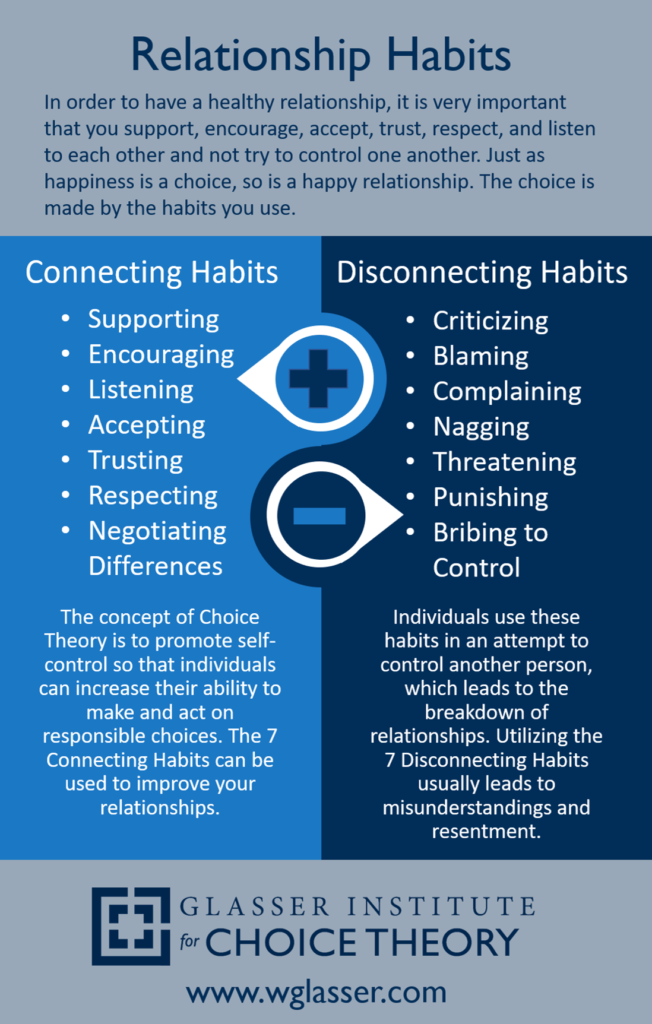
However, by actively choosing to practice the seven connecting habits—caring, listening, supporting, encouraging, respecting, trusting, and negotiating—within an External Control environment, relationships within the church can thrive.
In doing so, you will not only avoid harm but also intentionally reflect the light of Christ by embodying Christ-like behavior.
My Beliefs
I hold the belief that God is the purest form of external control—and the only one I fully accept.
His authority and guidance are always for our own good.
But here’s the key difference: in the New Testament, we see God stepping back from using external control as much.
Instead, He works through the Holy Spirit, who resides within us, guiding us from the inside out.
Final Thoughts
As a leader, I don’t recommend blending both approaches.
Instead, I firmly believe in following the model God has set: offering clear guidance rooted in His truth while trusting the Holy Spirit to work within each person’s heart.
This is how we foster spiritual growth and genuine connection with God.
I recently volunteered to run a plenary at a church retreat on reconnecting the community.
One of the reasons why I volunteered was because I felt that teaching Choice Theory (CTRT) in hopes of building satisfying relationships was applicable here.
I took a risk and decided to step out of my comfort zone to engage with the audience and allow for some freedom and fun within the plenary.
1. Relating with the Survival need people
The first thing that I did was try to relate to the people who may be unfamiliar with the community.
The first audience interaction I did was to invite the people who also wanted a sense of safety to raise their hands.
I shared about how having a sense of safety is important to me and how I’m going to take a risk by encouraging audience interaction.
2. Relating through the sharing of Quality World (QW) pictures.
When people signed up for the retreat, we invited them to share their hopes for attending the retreat.
By reading about their hopes (which belong in their QW), I was able to immediately relate to them. I shared about my hopes to build connections within the cluster, even beyond cells.
I divided them into smaller groups for quality sharing and invited them to share within their groups on their definition of Quality time.
Through the sharing, they discovered that they have common ideas of what was quality to each of them.
Landing point 1:
The more we agree with each other, the stronger our relationship is. I encouraged them to focus on growing what’s common between all of them, instead of focusing on the differences.
Relating through the sharing of Perceived World pictures
I invited them to choose a Bible verse about community that resonated with them and share within their group what the verse means to them.
This time, I invited three people to share their PW pictures of the group’s interactions.
They observed:
Common Bible verses
Different perspectives on the Bible verses
I observed:
Laughter
Acceptance of each other’s perspectives
Landing point 2:
There is a time and space for us to read the Word of God by ourselves for self-edification. When we come together and talk about the Word of God, we allow our head knowledge to become heart knowledge. As we come together and fellowship, we find that we have more and more in common and sometimes allow ourselves to accept even the differences.
For the last point that I was delivering on connecting habits, I invited a member of the audience to pretend to be someone with whom they have a painful relationship.
I had a conversation with this person, nicknamed Dodo, and applied most, if not all, of the 7 connecting habits.
I asked Dodo how he felt – he felt a sense of warmth. I asked the audience what they learned from observing the interaction: I heard many agreements about the 7-Connecting habits.
The point that I delivered to the audience was this:
Landing Point 3:
The only person that we can really control is ourselves (paraphrased from Choice Theory Axiom 1). By applying the 7-connecting habits, we can hope to be able to form satisfying relationships.
In closing, I got everyone to gather in a circle, and each shared something that they learned. There were many different perspectives and quality world pictures.
I really liked that I took a risk to interact with the audience.
On hindsight, what I might have done differently was to invite each participant to apply the 7-connecting habits in response to each other’s self-evaluation.
As much as this plenary was intended to be a platform for learning for others, I feel that I’ve learnt some things about myself:
When I meet my Survival need (I feel safe), I can choose to take the next step in meeting my Power need (Achieving something).
I can teach Choice Theory by inviting people to engage with me as I apply the concepts of Choice Theory, without preaching Choice Theory and leaving it as knowledge.
I’m taking a risk in writing this very vulnerable post – my objective is not to assume nor judge.
First Generation vs Second Generation
I was the first person to accept Jesus in my household. I have never been exposed to the bible growing up – and for me, I had firsthand perspective of God from my journey with Him.
I have been asking people “when did you accept Jesus in your life ?” and struggled to understand why Christian transformation was a gradual process for people who have grown up in Christian households.
In my limited interactions to talk about the topic, what I’ve learnt is that everyone’s perspective of God is built differently. For the second generation Christians, their perspective of the Father is built on what they observe as they grow up – their positive and negative experiences.
For the first generation Christians like myself, my perspective is simply – before Christ, I was a sinner. After Christ, I immediately began to see the internal change in my life that was a result of me following Jesus.
I can now relate with the people who see the Father through the lens of their Christian experiences since young.
Hopes (Quality World) vs Experience (Perceived World)
The one thing that I think is common between generation of Christians is this:
The frustration/pain that we feel when the life we see in the Bible is not the life we are currently experiencing.
For the creation waits in eager expectation for the children of God to be revealed. For the creation was subjected to frustration, not by its own choice, but by the will of the one who subjected it, in hope that the creation itself will be liberated from its bondage to decay and brought into the freedom and glory of the children of God. We know that the whole creation has been groaning as in the pains of childbirth right up to the present time.
Romans 8:19-22 NIV
The difficult part for me as a pre-believer was accepting that I wanted a relationship with God. When I accepted Jesus into my life, it was with heartfelt knowledge.
For my friends who know Jesus with head knowledge – I say this gently without judgement – I imagine the frustration of knowing the promises of God in the bible, and reconciling with exceptionally painful experiences, without the “first love” personal experience with Jesus.
I am guilty of taking my first experience with Jesus for granted – the anecdotal evidence of my faith.
Seeing His Power vs Seeing His Heart
“All things have been committed to me by my Father. No one knows the Son except the Father, and no one knows the Father except the Son and those to whom the Son chooses to reveal him.
Matthew 11:27
When I see an answered prayer, signs, a breakthrough in my life, providence, and even the arrival of my life partner – things that are out of my control – I see His power revealed clearly.
If I just take His power at face value, I do not know the Father’s heart.
What could He be thinking of as He did this for me ?
What was His emotions as He did this for me ?
I would only be knowing Him for His power – and end up only knowing Him when He acts.
I risk cherry-picking verses here – there might be more appropriate verses
In your relationships with one another, have the same mindset as Christ Jesus:
Who, being in very nature God, did not consider equality with God something to be used to his own advantage; rather, he made himself nothing by taking the very nature of a servant,
being made in human likeness.
And being found in appearance as a man,
he humbled himself
by becoming obedient to death—
even death on a cross!
Philippians 2: 5-11
“Why were you searching for me?” he asked. “Didn’t you know I had to be in my Father’s house?”
Luke 2:49
Jesus’ heart was for the Father – a Son who cared more about the Father as a whole.- instead of just focusing on His power.
And if I reflect on my own walk with Jesus… there has been times where I do things, because compliance with the Father was important to me. I basically behave in fear, or grudgingly “you win because you are God lah” attitude.
And I think its okay to have a reverence for the Lord. To also know His authority over me.
But is there a time and space for me to also say… for example… “Disciple-making is important to the Father. I agree with Him, and Disciple-making is important for me too.” without any connotations of obligation – accepting a quality world picture from any else’s life is one sure way to build a healthy relationship.
My theory is this: If I continue to accept things that matter to God, to be important to me as well, I am learning to be like Christ – not just towards others, but also towards God.
And when my actions and thoughts for the Father are similar to that of Jesus, I have hope that my feelings and my human spirit would catchup too – and be able to feel… for example: compassion for the lost as Jesus did too.
And when I have a total behaviour that is similar with Jesus… I think I can confidently hope for more of the Father to be revealed to me, because I am now seeing the Father through a lens that is similar to Jesus,
If more of You, means less of me, take everything, Lord.
In Jesus Name,
Amen.
More Like Jesus
I felt personally ministered as I listened to this song. The lyrics were the inspiration for my post.
This world is dying to know who you are
I think it applies to both prebelievers, and believers struggling to understand and hold on to the faith.
I used to struggle with self-esteem issues and often practised self-criticising.
Interactions Shape How We Learn
After much contemplation, I realised that I learned to be a self-critic from my interactions with others.
Much of what I learn is through interacting with other people. For example, I learned teamwork through my interactions with classmates and obtained knowledge from interacting with teachers.
What a Baby Teaches Us About Learning Behaviour
I learned from Choice Theory that a baby also quickly learns that the way to get food is to express hunger by crying loudly.
As he/she grows, the baby tries the behaviour of crying for all other things that he/she wants to get. If crying does not work, then he/she is likely to try a new behaviour.
Returning to the Self-Critic Within
Back to my topic of self-criticism.
I’ve allowed myself to be exposed to criticism over the first two decades of my life and have accepted the criticism as truth, as I hear enough of them multiple times.
A False Picture of Safety
I also accepted a picture of myself being safe from criticism by simply allowing others to have a say over things and denying myself the opportunity to speak up.
Over time, as our life paths diverge, these people go away, and people who trust me come into my life.
How I Kept the Picture Alive
The picture of being safe (Survival Need) remains prominent in my head, and the irony of it all is – I creatively keep the picture by criticising myself to temper my need to be heard (Power Need).
After all, I’ve learned that putting myself out there may earn me more criticism from others. Why speak up when I can be safe by keeping silent?
Love as the Turning Point
Mark 12:30-31 says:
“Love the Lord your God with all your heart and with all your soul and with all your mind and with all your strength.” The second is this: “Love your neighbour as yourself.” There is no commandment greater than these.” Mark 12:30-31 NIV
I learned love from God when I accepted that He sent Jesus to die for my sins. As I interact with Him with all my heart, soul, mind, and strength, I learn more about how He loves me and how to reciprocate in this relationship I have with Him.
Learning to Love Myself
And as I discover how He shows love to me presently – through a community that cares for me, through my wife who accepts me for who I am, through people who are supportive of me – as time goes by, I learn to also care, accept, and support myself. I basically learned how to love myself as a new behaviour.
A Quieter Self-Critic and a Louder Love
The self-critic in me is a lot quieter now.
And when I allow myself to be loved and accepted by others as well as myself, I also learned the language of godly love and know to behave lovingly towards my neighbour because I know love for myself.
A dog that I met in Cebu. We watched a sunset together.
I’ve come to realize that one of the ways I learn is through my interactions with people. I learn about what matters to them, the way they behave, and perhaps quickly discover that we actually have some things in common.
During my CTRT Training, I learned that in a CTRT conversation, what I offer the other party is an experience – of me applying Choice Theory. As I apply Choice Theory, I also find myself having the opportunity to teach Choice Theory through my behaviors, instead of simply downloading information.
In my application of Choice Theory, I strive to apply the Connecting Habits (left-hand side) and stay away from the right-hand side.
Fun fact: I tend to complain quite a bit as a learned behavior, and I’ve found that doing so hasn’t brought any long-lasting satisfaction into my life.
I send to anyone who cares to listen to me. Hahaha.
1. I can teach myself Choice Theory by practicing the 7 connecting habits with myself first.
I’ve had times where I allowed my behavior to be driven by anger. When I do so, what I may be telling people through my body language is that ‘Wilson is someone who is unapproachable.’
I tried three times before I managed to use 3 connecting habits with myself.
In an example of a failure to get a parking space:
In my head, I told myself: ‘I am upset because I didn’t get a parking lot. It is not my fault that I did not get the parking lot. I want to have the space to think about it and regain control of my emotions.’
I accepted that I was upset.
I stopped blaming myself for not being able to get the parking lot.
I started reminding myself that I can trust myself as a planner.
I negotiated differences with myself: ‘Okay, I can’t have the parking lot, but I still want to remain in control of my emotions.’
I was able to break the loop of thinking negatively (Situation A of Choice Theory Brain Chart) and entered Situation B of Choice Theory Brain Chart) in a span of 15 minutes to gain control of my behaviour.
When I think about how I took 1 entire day of being upset on my previous attempts… I think I’ve come pretty far.
What I learned in having a relationship with myself is that I am capable of growth as long as I continue trying.
This is my favourite GetGo car – the Honda Vezel. Great acceleration. Bad idea to tap the brakes according to the beat of the song. Link comes with my referral code: SDSBREEU
2. I can teach others Choice Theory when I practice the 7 connecting habits in my attempts to give information.
In the span of the 15 minutes where I was driven by feeling upset, I had an annoyed look on my face. With this expression, I told the person, ‘I don’t want to talk about it now because talking about it does not help.’
In my head, there was a picture of me speaking very calmly and saying, ‘Ah yes, could you give me some space?’ I tried my best to maintain a poker/calm face, but alas, my voice still came out annoyed, even though I was thinking of things as rationally as I could.
The person, upon receiving the information that I was annoyed, started to perceive blame and went into self-blame too. I then realized that because everyone’s perception is different, I can help myself out by giving information about what’s within my perceived world and what I want.
Later on in our interaction, I took one additional step by saying, ‘I’m sharing this information with no intention to blame. I might look annoyed at the moment, but in my head, I’m waiting for my emotions to catch up. Is it alright with you if I had some space to process things?’
In doing so, I’ve communicated that I have accepted the person’s perception that I look annoyed. I also shared my perception that I’m waiting for my emotions to catch up.
Taking on this new behaviour, I’ve also taught the person that I am choosing to take control of my situation instead of remaining upset.
3. I can teach others about a life in Jesus, as I live out my life in Him.
5 In your relationships with one another, have the same mindset as Christ Jesus:
6 Who, being in very nature[a] God, did not consider equality with God something to be used to his own advantage; 7 rather, he made himself nothing by taking the very nature[b] of a servant, being made in human likeness. 8 And being found in appearance as a man, he humbled himself by becoming obedient to death— even death on a cross!
9 Therefore God exalted him to the highest place and gave him the name that is above every name, 10 that at the name of Jesus every knee should bow, in heaven and on earth and under the earth, 11 and every tongue acknowledge that Jesus Christ is Lord, to the glory of God the Father. Philippians 2:5-11 NIV
While I was in a car with a group of friends, I was sharing about how strongly I resonated with teaching Choice Theory through how I interact with others.
Then, I had an epiphany that perhaps this was one of the ways I teach people about Jesus.
By having the mindset of Christ, I can learn to be like Him and demonstrate His love, joy, peace, forbearance, kindness, goodness, faithfulness, gentleness, and self-control towards others and myself.
My intention would not be to prove that I am Christ-like, but rather to sow seeds and share what God has given me through His Spirit. As I demonstrate more of it in my immediate relationships, I also teach people how I apply His teachings in my life.
Over the years, I’ve heard reasons about why it’s important to join a cell.
a) Learn about God’s word
b) Be accountable to each other
If there was an official list, I would want to add these to the list:
c) To experience and learn the love of God through others
d) To share and teach what I’ve learned about the love of God with others.
I think that learning is a lifelong journey – and I will continue to learn and teach others through an application to my life.